Turning Performance Reviews into Real Development Conversations
Many companies are gearing up for performance reviews again. For a lot of people, these still feel more like evaluations than opportunities for growth. Forms, scales, goal achievement—and at the end, some are left wondering: "Am I really being seen here, or just judged?"
What if we radically shifted the focus? Away from "What’s missing?" and toward "What’s already working—and how can we make more of it visible?"
From Evaluation to Development
Traditional performance reviews often follow a deficit-based logic: They spend a lot of time discussing what went wrong, where someone fell short of expectations, and which "weaknesses" need to be "fixed." The intention is usually good—but the impact is mixed. Many people leave these conversations feeling drained rather than empowered.
A strengths-based approach starts from a different place. It begins with what’s already there: talents, attitudes, and behaviors that are effective in daily work and contribute to success. The goal isn’t to "fix" people but to use their existing strengths more consciously and intentionally.
Strengths as an Anchor: Shifting Perspectives in Conversations
A fictional example: In a recent client conversation, this was exactly the topic. The starting question: How can we design our annual review so it energizes instead of drains?
The approach was surprisingly simple:
- The employee and manager look together at the top strengths.
- Not all of them—just two or three that really make a difference in daily work.
- Both describe how strongly these strengths are currently perceived and used—honestly, subjectively, on a scale.
Key point: It’s not about perfect measurability but about an honest impression. The scale is a conversation starter, not a verdict. From two perspectives—self-assessment and leadership assessment—a shared picture emerges. And from that, not a deficit, but a goal.
The key question might be:
"If this strength were a little more visible in a year, how would we notice it concretely?"
A Fictional Example: From "You Need to Improve" to "Let’s Amplify This"
Imagine: A team leader in a mid-sized company has her annual performance review with her manager. Until now, it’s been pretty standard: reviewing goal achievement, discussing areas for improvement, and agreeing on where the team leader "needs to get better."
This year, they decide to try something different. The starting point is the team leader’s strengths—based on observations and a brief strengths assessment the company introduced. Three strengths take center stage:
- Relationship-building – She quickly builds trust.
- Structuring – She brings clarity to complex topics.
- Reliability – She reliably keeps commitments.
The manager asks the team leader to rate each strength on a scale of 1 to 10—not "how good" she thinks she is, but how visible and effective the strength is in her current workday. The team leader’s self-assessment:
- Relationship-building: 7 ("Strong in my team, less visible in cross-departmental projects.")
- Structuring: 6 ("Good in my own area, could be more present in strategic meetings.")
- Reliability: 8 ("This is something everyone can rely on.")
Then the manager shares her perspective. Interesting: She rates the team leader’s relationship-building at 8, but structuring at 5. Instead of conflict, these differences spark a conversation:
- Where do you already notice this strength clearly?
- Where do you see untapped potential?
- Where, as your manager, would I like to see this strength more often or more visibly?
Instead of "You need to work on your visibility," a new goal emerges:
"If your strength in structuring were one point higher next year—from 6 to 7—how would we notice that in daily work? In meetings? In projects? In collaboration with other departments?"
The team leader comes up with concrete ideas:
- She’ll prepare short visual summaries for cross-departmental meetings.
- She’ll consciously take the role of summarizing decisions at the end of meetings.
- She’ll actively ask colleagues for feedback on when her structuring was particularly helpful.
The result: What could have been a potentially critical topic ("You’re too quiet in leadership meetings") becomes a strengths-based development direction ("Your strength in bringing structure should be more visible in these meetings").
Why It Works: A Quick Look at Positive Psychology
Positive Psychology—pioneered by figures like Martin Seligman—has spent years exploring what makes people resilient, engaged, and high-performing. A key finding from research and Gallup studies: People who regularly use their strengths at work are
- more engaged,
- more productive, and
- more emotionally connected to their company.
Important note: This isn’t about ignoring weaknesses. It’s about leveraging what already energizes people. Often, just one point higher on that imaginary scale makes a difference:
- A small boost in impact,
- Using the strength more intentionally in the right moments,
- A clearer language for what someone does well.
This is how real performance development happens—not by forcing people to change, but by helping them see where their strengths already carry them—and where they could take them further.
Practical Steps for Strengths-Based Performance Reviews
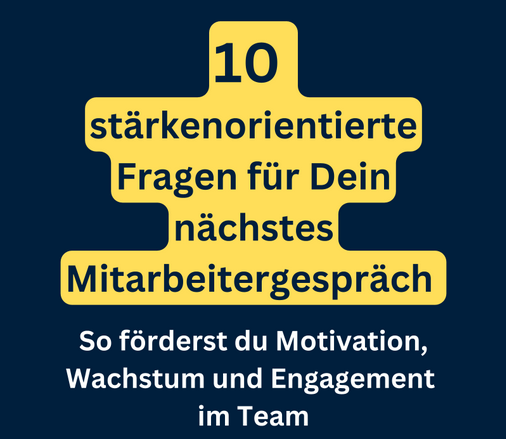
If you want to make your next employee conversations more strengths-focused, these steps can help:
- Prepare with a strengths focus
Ask your team members to note two or three strengths they observe in themselves at work. Add your perspective as their manager. - Use a shared scale
Together, rate how visible and effective these strengths are right now—on a subjective scale. Use differences as conversation starters, not points of contention. - From strength to goal
Frame development goals not as "fixing flaws" but as "using strengths more consciously." Guiding question: "What would +1 on this scale look like—concretely?" - Small, concrete experiments
Agree on one or two small behavioral changes to try in daily work. Better to start small and actionable than big and abstract. - Plan a follow-up
Schedule a check-in after a few weeks: What’s changed? Where was the strength particularly effective? What’s next?
Midway Takeaway: Energize, Don’t Drain
Performance reviews don’t have to be a draining obligation. When you shift the focus from deficits to what’s already working, the quality of the conversation changes noticeably. Employees experience themselves as active participants in their development—not as subjects of an evaluation.
Maybe this year is the right time to lead your performance reviews in a way that energizes—you, your team, and your shared success.
Originally published on LinkedIn.
Related articles

Want to experience strengths-based leadership?