Turning Employee Reviews into Moments of Sunshine
Why traditional employee reviews often fizzle out
A fictional example: At a mid-sized IT company, a team lead conducts standardized employee reviews every three months. The agenda never changes: project progress, goals for the next quarter, feedback on collaboration. The conversations last 45 minutes—and leave both sides feeling like they’ve just ticked a box. Team members walk out with a list of new to-dos, but without real enthusiasm. The team lead wonders why motivation often drops afterward instead of rising.
The problem: Many employee reviews follow a deficit-based pattern. They focus on gaps (“What didn’t go well?”), corrections (“How can we improve this?”), or purely operational topics (“What milestones are coming up?”). The result? Conversations that drain more energy than they give. Yet every one-on-one holds the potential to do the exact opposite—create a moment that feels like sunshine: warm, uplifting, and full of energy.
Strengths-based approach: The game-changer
Positive psychology shows that people grow where they can use their strengths. Gallup research confirms that employees who apply their strengths daily are 8.9 times more likely to be emotionally engaged. But how do you put this into practice during an employee review?
The key lies in the type of questions you ask. Instead of hunting for problems, strengths-based questions focus on what’s already working—and how to expand those positive aspects. This doesn’t just create a more pleasant conversation; it also drives sustainable growth. When people know their strengths and use them intentionally, they’re more motivated, resilient, and productive.
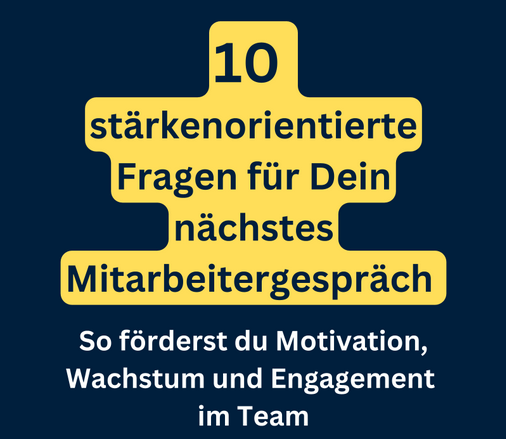
10 questions to unlock energy
Here are ten questions that can turn your next one-on-one into a true moment of sunshine. They’re grouped into three categories: Energy, Growth, and Collaboration.
Energy: What excites you?
- “Which task or project has brought you the most joy in recent weeks—and why?”
- “When was the last time you felt truly ‘in your element’ in your role?”
- “What gives you energy in your daily work? Is there something we could do more often?”
Growth: What drives progress?
- “If you could apply one of your strengths even more intentionally—which would it be, and what would that look like?”
- “Which skill or knowledge would you like to develop further to have even more impact?”
- “Is there a project or initiative where you’d like to take on a bigger role?”
Collaboration: What strengthens the team?
- “Who do you enjoy working with most—and what makes that collaboration so great?”
- “Is there something we could do better as a team to support each other even more?”
- “If you could change one thing to make teamwork easier—what would it be?”
- “What do you value most about our team culture—and how can we preserve it?”
A fictional example: From chore to highlight
Imagine: A sales team of seven prepares for their annual employee reviews. Until now, these meetings have felt like a necessary evil. But this time, the team lead tries a new approach. She sends out a short survey beforehand with three of the questions above—including: “Which task has brought you the most joy in recent months?” and “Which strength would you like to use even more often?”
In the conversation itself, she doesn’t start with goal-setting but with the survey responses. For one employee in customer service, it turns out she loves solving complex customer requests—because it lets her use her analytical skills and patience. The team lead asks: “How could we give you more of these tasks without overloading your daily work?” Together, they brainstorm ideas: The employee will now train new colleagues in this area and become the go-to person for tricky cases.
The result: The employee leaves the conversation smiling—and feeling seen and valued. The team lead hasn’t just set a concrete development goal; she’s also noticeably boosted the employee’s motivation. Best of all, the conversation energized both of them instead of draining them.
Expert insight: The science behind the impact
The strengths-based approach is rooted in principles of positive psychology, particularly Martin Seligman’s work. His PERMA model describes five pillars of well-being: Positive Emotions, Engagement, Relationships, Meaning, and Accomplishment. Strengths-based questions target these pillars—by asking about positive emotions (“What brought you joy?”) or meaning (“Which task makes you feel like you’re making a real difference?”).
Gallup research also shows that teams who regularly discuss strengths are 12.5% more productive. The reason: A strengths-based approach creates psychological safety—an environment where people feel comfortable sharing ideas and taking ownership.
Key takeaway: Small questions, big impact
Employee reviews don’t have to be tedious obligations. With the right questions, they can become true highlights—moments that energize instead of drain. The key is shifting the focus: away from deficits, toward strengths; away from purely operational topics, toward what truly motivates.
Give it a try: Pick one of the questions from the list for your next one-on-one and observe how the dynamic changes. You’ll be surprised how much sunshine is possible—even on gray days—when you ask the right questions.
Originally published on LinkedIn.
Related articles

Want to experience strengths-based leadership?