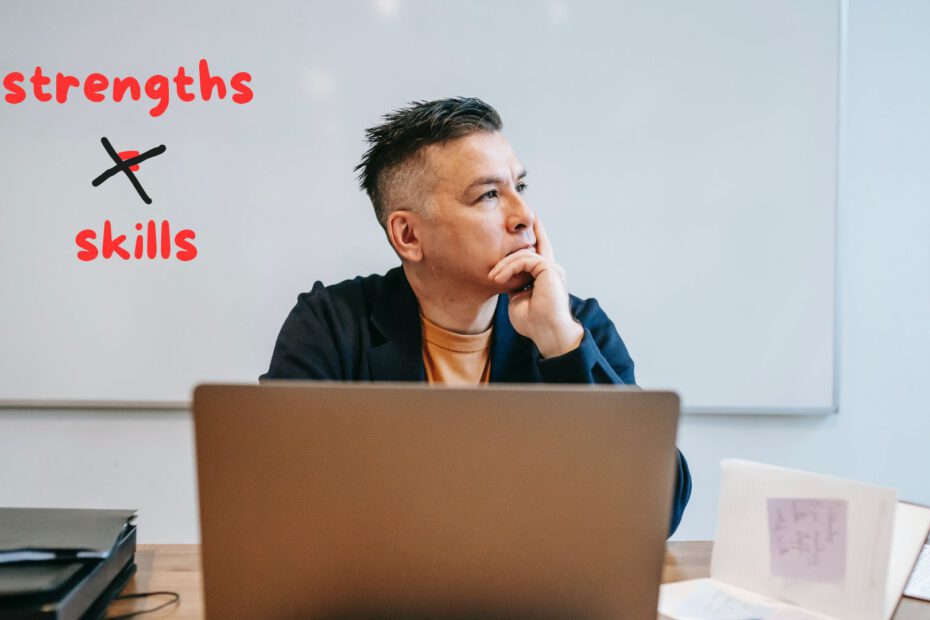
More Than Just Skills: The Key Difference Between Competencies and Strengths
I love interviews and job conversations—I’ve sat through quite a few in my leadership roles. Over time, you develop a set of favorite questions, and one of mine is non-negotiable:
What are your greatest strengths?
The answers came quickly, but they often surprised me. For example: “I’m great at project management,” one candidate said. “I speak three languages fluently,” another added. And this wasn’t the exception—it was the rule. Here, something fundamental gets mixed up. Instead of talking about strengths as character traits or natural talents, candidates listed their acquired competencies and skills.
This mix-up isn’t rare. It reflects a common tendency in our society: we tend to see our professional qualifications and abilities as our “strengths,” while our true, personal strengths often stay in the shadows. But what exactly is the difference between a competency and a strength? Why does it matter to understand this distinction, and how can this knowledge shape our careers and personal growth?
In this article, I want to explore these questions and show how a clear understanding of our real strengths and competencies can positively impact not just our own careers, but also how we work and interact in our professional lives.
Let’s start with a definition:
Competencies are learnable skills, knowledge, and experiences. They include measurable or acquirable abilities typically developed through education, training, or hands-on experience. Examples of competencies include expertise in specific areas like financial management or software development, language skills, technical abilities, and soft skills like team leadership and effective communication. They can be expanded through formal education, professional development, and practical experience.
Strengths, on the other hand, are inherent qualities of a person, often seen as natural talents or character traits. They’re part of your personality and deeply rooted in your individual identity. Strengths include innate talents like artistic creativity or an intuitive grasp of numbers, character traits like empathy and patience, and personal qualities like resilience and adaptability. Strengths can be developed through self-reflection, feedback, and conscious practice, but they’re not “learnable” in the same way as competencies.
In short, competencies are specific, learnable skills, while strengths are broader, often innate qualities. Both play a crucial role in personal and professional development.
Why is this distinction so hard for us?
The difficulty in distinguishing between competencies and strengths stems from both societal norms and personal perception. In a society driven by performance and measurable results, the focus is heavily on competencies—learnable and quantifiable skills. These are nurtured early in schools and other educational institutions and often form the basis for career advancement and recognition. Since competencies can be proven through certificates, degrees, and specific achievements, we tend to see them as the primary indicators of our professional suitability.
At the same time, many people find it harder to talk about their true talents—their natural strengths. These strengths, like creativity, empathy, or leadership qualities, are often deeply rooted in personality and taken for granted. They’re not always obvious or easy to measure, and traditional education and career paths pay them less attention. As a result, they’re often underestimated and less emphasized in professional contexts.
There’s also a certain reluctance to openly discuss personal talents, as it can sometimes be misinterpreted as boasting or overconfidence. This leads to a situation where individual strengths remain in the shadow of formal competencies, and their importance for personal and professional success isn’t fully recognized. This imbalance in the perception and recognition of competencies and strengths is a challenge we need to overcome in the modern workplace.
So which is more important?
The emphasis shouldn’t be on an “either-or” between competencies and strengths, but on recognizing that the combination of both is the key to success. Competencies are essential for performing specific tasks and functions; they form the technical foundation of a job. On the other hand, personal strengths are what allow an individual to perform these tasks in a unique and often more effective way. Strengths like adaptability, creativity, or emotional intelligence enable you to tackle challenges innovatively and shine in a team environment.
The synergy of competencies and strengths leads to a holistic way of working. Someone who has both the necessary competencies and strong personal qualities can not only complete tasks but also bring new perspectives and solutions. This is especially valuable in times of rapid change and uncertainty, where flexibility and creativity are just as important as technical knowledge and expertise.
Companies and organizations that recognize and foster both the competencies and strengths of their employees create a more dynamic and innovative work environment. This leads not only to higher employee satisfaction and retention but also to improved overall performance. Therefore, it’s crucial that both personal career planning and company culture develop a balanced understanding and appreciation of the combination of competencies and strengths.
The Competency-Strength Synergy Matrix
The realization that both competencies and strengths are crucial for professional success leads us to a useful method for understanding how these two elements interact in different combinations: the Competency-Strength Synergy Matrix. This matrix helps categorize people based on the interplay of their competencies and strengths into four distinct groups.
The four quadrants of this matrix represent different combinations of high or low levels of competencies and strengths. Each quadrant represents a specific group of individuals with unique challenges and potential in terms of professional development and performance.
High Competency, High Strength: The Superheroes
This quadrant represents people who excel in both their professional competencies and personal strengths. They can perform tasks efficiently and effectively, deliver outstanding results, and fit well into their role or profession.
A fictional example: An experienced software developer with strong technical skills (competency) and exceptional problem-solving ability (strength).
This group makes a significant contribution to a company’s success. Their ability to complete tasks competently and with personal strengths can lead to higher revenue and profitability. Their balance also fosters a positive work environment, boosting employee satisfaction and well-being.
High Competency, Low Strength: The Magicians
People in this quadrant have the necessary professional skills but lack the personal strengths needed to optimally perform their role. They can get the job done, but they may struggle with soft skills like teamwork or creativity.
A fictional example: A highly skilled accountant with excellent financial management knowledge (competency) but difficulties in teamwork and communication (strengths).
While their high competency can contribute to the company’s financial success, their lack of personal strengths might negatively impact team morale and overall employee satisfaction. Targeted personal development in these areas can enhance their effectiveness and contribution to workplace well-being.
Low Competency, High Strength: The Explorers
This quadrant describes people who have valuable personal strengths but lack the necessary professional competencies for their role. These individuals might thrive in roles that better match their strengths.
A fictional example: A salesperson with excellent interpersonal skills and persuasiveness (strengths) but limited knowledge of the products they’re selling (competency).
Their personal strengths can contribute to a positive work environment and high employee satisfaction. However, developing their professional skills is crucial to making a direct contribution to the company’s revenue and profitability.
Low Competency, Low Strength: The Apprentices
People in this quadrant have deficits in both professional competencies and personal strengths. They may struggle to perform their tasks and might need additional training or a career realignment.
A fictional example: A new employee in a marketing department who lacks specific marketing knowledge (competency) and doesn’t have strong creative or analytical abilities (strengths).
This group faces the biggest challenge in directly contributing to company goals. Their development in both dimensions is crucial. With the right support, however, they can become an important resource for the company, both in terms of financial goals and employee well-being.
This matrix isn’t just a tool for self-reflection—it’s also a guide for HR professionals to understand the individual needs of their employees and support them accordingly.
What’s the next step?
For decision-makers and leaders, three key steps are crucial to fully unlock the potential of competencies and strengths:
- Raise awareness and clarify the difference: Explain the distinction between competencies and strengths within the company and emphasize the importance of both for success.
- Support targeted development: Create individual development plans that consider both competencies and personal strengths to foster holistic employee growth.
- Establish a culture of learning: Build a company culture that supports continuous improvement and personal development to boost overall performance and employee satisfaction.
Related articles

Want to experience strengths-based leadership?
Thank you for this insightful article, which addresses exactly what we practice every day—and where we urgently need a shift in thinking and a more nuanced perspective.
In my experience, many people haven’t fully discovered or tapped into their natural abilities, their strengths, their talents.
Often, this works better with the help of others who have known the person for a while and have observed or experienced their talent.
I believe that when we unlock people’s talents, we achieve exceptional and sustainable performance—for the company, too. At the same time, employees no longer “struggle” with their work but do it with joy and ease. Talent holds so much potential, and when talent and interest come together, competencies can be acquired in no time. The future of companies lies in recognizing and embracing the talents of individuals and skillfully “piecing them together.” If we expand on this, the skills shortage will be a thing of the past, employee satisfaction will rise, and so will company results. The businesses that are already doing this are leading the way. It’s only a matter of time before the market shifts significantly in this direction… and that’s a good thing.